In the non-conference games some teams were heavily ball denying Weiss and she started taking some pretty bad shots as a result. I’m curious to see how this evolves…
I wonder if Penn had an especially good defender on her. Did not see the game.
Opening Weekend Takeaways (with one game still to play)
An exciting first weekend so far. The early returns reinforce a familiar theme: the Ivy is tighter top-to-bottom than preseason rankings—or fan priors—would suggest. I’d be surprised if this is the last upset we see.
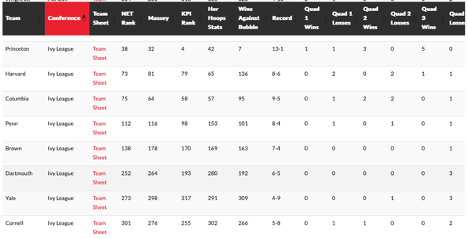
Two thoughts on Columbia’s loss:
-
Context matters. A NET 321 team knocking off a NET 58 team is a headline result on its own. More striking: it’s only Columbia’s third Ivy loss to a non-Princeton opponent in the post-COVID era (49–6 in Ivy play over the past four seasons).
-
Perspective matters more. It’s Game 1. There is a lot of basketball left. Columbia lost its third game to Penn in 2023 and still went 12–2. From an Ivy tiebreak standpoint, this isn’t catastrophic—the Lions are likely to have stronger wins before anything comes down to the Cornell line.
Looking to Monday: if Yale can upset at Brown, the perceived bottom half of the league becomes legitimately more dangerous than it has over the past four seasons: great for fans, uncomfortable for contenders. I still need to see more from Cornell before putting the Big Red into serious Ivy Madness conversations (worth remembering that last season a 2–12 Dartmouth team opened by beating Brown and Penn).
Game 2 Game of the Week:
Columbia at Harvard next Saturday. This is consequential. Both teams should treat it as close to a must-win for hopes of NCAA at-large positioning, and realistically, both probably need a double-digit win to meaningfully move NET and WAB. If a team suffers a double digit loss, protecting a WBIT bid and focusing on Ivy Madness is a more realistic path than an NCAA at large (the needed WAB improvement is likely to great).
Two nail-biters in a repeat of last year’s 2–3 and 4–5 matchups (credit to the scheduler—someone actually did the homework). Columbia and Brown grabbed the wins they needed to position themselves for a potential Tier 1 tiebreaker. Cornell followed up with a second straight upset, and the Lions’ win, while technically a “slight upset”, was basically a pick’em.
Week 3
1) Cornell’s litmus test
I’m most interested in Cornell’s next two: Brown at home, then Yale. This is a clean litmus test for whether the Big Red are genuinely in the Ivy Madness conversation or just enjoying a hot start. If Cornell gets to 4–0, with five more home games still ahead and a tiebreaker edge vs. Columbia already banked, they’re not just a nice start (like Dartmouth was last season), they’re a factor for the rest of the season.
2) Harvard’s “which lane are you in?” weekend
Next up: at Penn and at Princeton. Do the Crimson hold serve and stay in the mix for second, or do they slide into the larger scrum for 3–4 (and make the standings feel like a crowded group chat)?
Postseason snapshot
NCAA at-large:
-
Princeton is still the clear at-large candidate right now.
-
Columbia likely needs statement wins next weekend, and Harvard needs to win (or at least keep it very close) against Princeton to have any real hope of materially improving NET positioning.
WBIT watch:
- Princeton, Columbia, Harvard remain the most plausible WBIT profiles from the league at the moment.
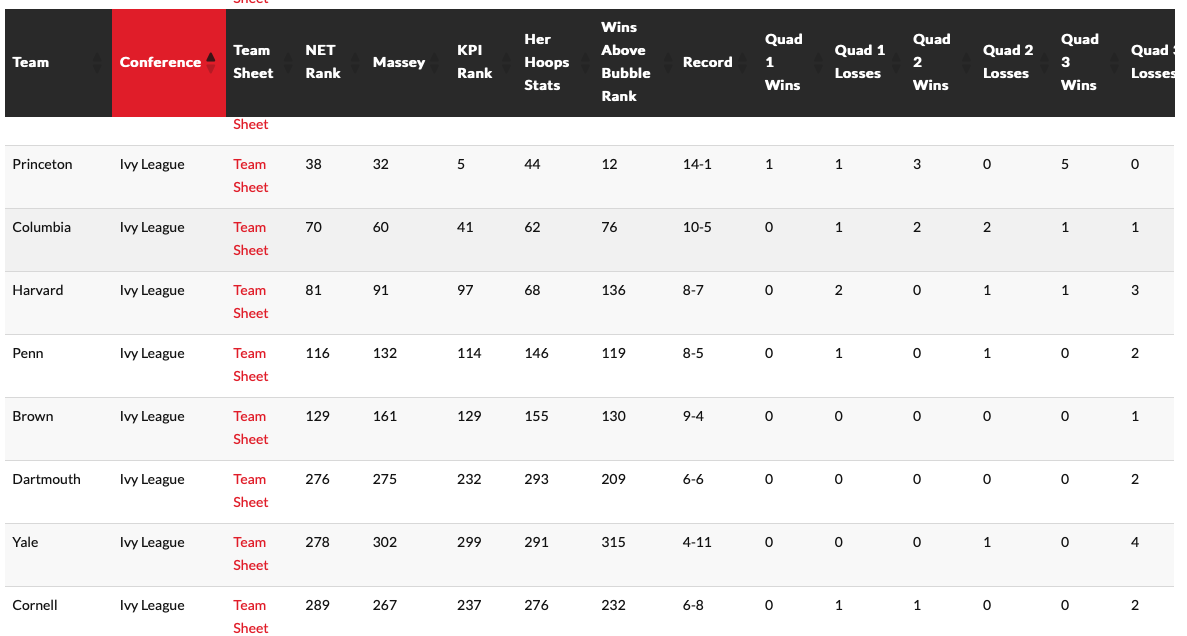
The headline from Games 3 & 4: Cornell drifted back toward the pack, which re-opens the scrum for the 4-seed.
Second-order effect: Brown now holds a slight NET edge over Penn (130 vs. 132). For both teams, the path is narrow: you likely need to go 2–0 against Cornell/Dartmouth/Yale and do it with enough quality (and margin, where it matters) to hold or improve NET. The harder question is whether either can steal one from Columbia, Harvard, or Princeton—that’s where the standings would separate.
Third-order effect: Columbia and Harvard remain in the NET 70s—solid positioning for a WBIT at-large, but not yet an NCAA at-large profile. Princeton has slipped to NET 39: still very much in the at-large conversation, but likely not in hosting range, and a couple of stumbles is how a comfortable résumé turns into a bubble sweat.
Game 5 preview: a mostly “take care of business” slate. The swing game is Princeton at Brown for its ripple effects on the 4/5 race. Columbia, Harvard, and Penn simply need to hold serve—no résumé-killing surprises.
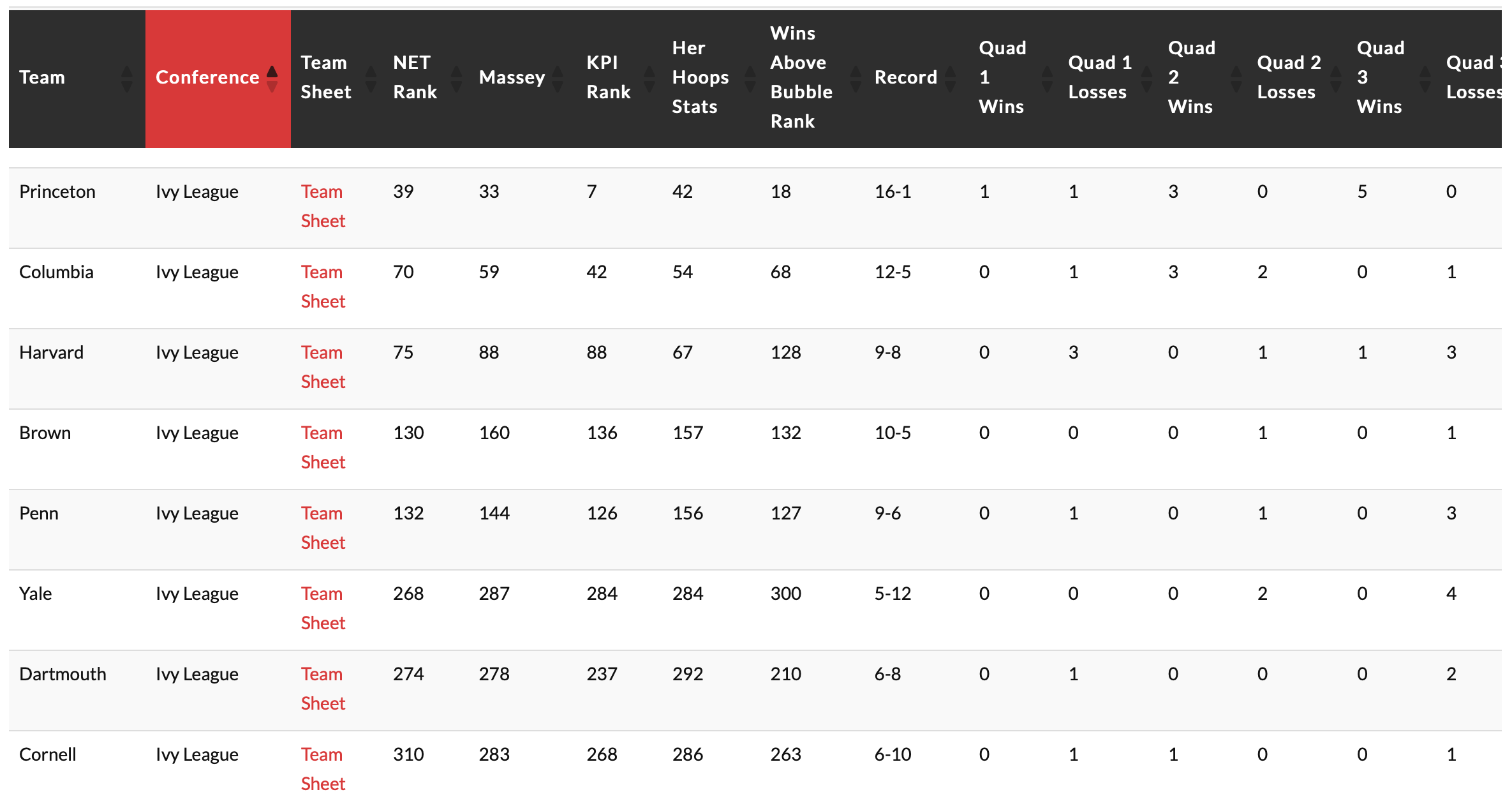
While Game 5s were fairly ho-hum on the floor, they were loud in the NET, insightful (and a little sobering for anyone hoping the deep bench would get a real run) evidence that coaches with post season aspiration need to manage outcomes beyond simply “W or L” even when the result is never in doubt.
-
Columbia: +57 vs Dartmouth (32 points better than expectation) → up 10 to NET 60
-
Harvard: +46 vs Cornell (31 better than expectation) → up 8 to NET 66
-
Penn: +27 vs Yale (19 better than expectation) → up 12 to NET 118
-
Brown: -9 at Princeton (1 better than expectation) → down 2 to NET 130 (Princeton stayed flat at NET 39)
These swings matter. NET positioning feeds directly into Ivy Madness seeding, WBIT at-large odds, and—at the very top—NCAA at-large résumé math. So what looked routine actually produced meaningful NET movement.
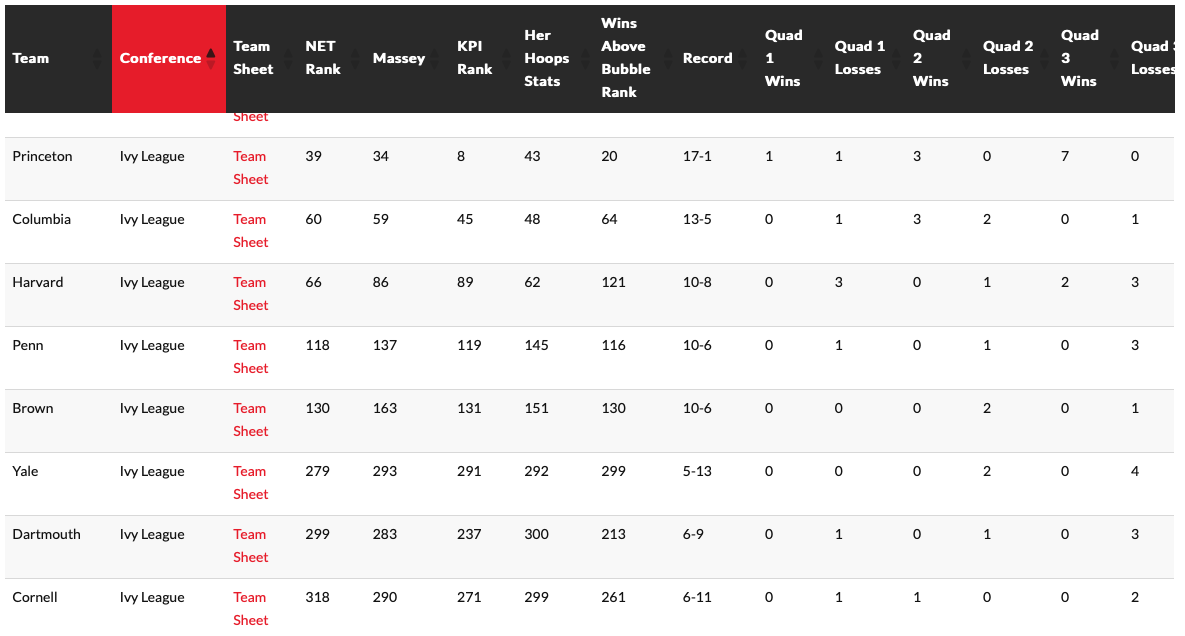
As Games 6 and 7 close the first circuit, the marquee matchup is clear:
Friday: Columbia at Princeton — the premier game of the weekend, with Princeton -6. And the Saturday mental and physical back to back adds a bit more old schedule drama than a single game weekend.
For Brown and Penn, Friday is close to must-hold-serve territory:
-
Brown at Dartmouth (Bears -10)
-
Penn vs Cornell (Quakers -15)
Saturday, has implications to the 2-3-4-5 positions:
-
Brown at Harvard (Crimson -13)
-
Penn vs Columbia (Lions -9)
For both the Bears and the Quakers, there’s a tier-two tiebreaker opportunity on the table, and with a win, a legitimate chance to push into the 2–3 conversation. For the Crimson and Lions, games against low 100 NET teams are in must-hold-serve territory and have outsized impact to their post season aspirations.
For Dartmouth, who are in search of their first Ivy win, Saturday’s home game against Yale is the only game they will be favored (2 points) the remainder of the season.
1 Like
First half of Ivy play has been terrific: close finishes, real parity, and a legit six-team race for Ivy Madness.
Tiers (as it looks right now)
Likely in Ivy Madness — Playing for 1 seed:
Columbia, Harvard, Princeton
Competing for Ivy Madness — Playing for 4 seed:
Brown, Cornell, Penn
Likely out of Ivy Madness:
Dartmouth, Yale
What the models say vs. what we’ve watched
The projection models I have seen, have Brown and Penn finishing 7–7, with Penn getting into Ivy Madness via tiebreakers / best-win (Columbia), and a Columbia–Princeton race for the regular-season title.
But the models feel a bit too analytical, no sight test watching the game – I am short the models as they feel overconfident about the separation of the top three and way too pessimistic on Cornell (basically have them going 1–6 the rest of the way). The on-court product says this middle tier is better than the math is pricing.
If 7–7 is the “bubble,” these are the swing games
The Seed 4 picture most likely comes down to whether someone can sweep this mini-triangle:
-
Penn at Cornell — Fri, Feb 12
-
Cornell at Brown — Fri, Feb 27
-
Brown at Penn — Fri, Mar 6
Ivy Tie Breakers
Tier 1: Head-to-head. Brown is 2-0, they’re positioned well for tiebreak chaos.
Tier 2: Best Ivy Win. Cornell & Penn, with wins over Columbia
Tier 3: NET. Penn (126), Brown (129), and Cornell (306)
Schedule leverage
Home/road split isn’t everything, but it helps the Bears:
-
Brown: 5 home games left
-
Cornell: 4
-
Penn: 2
And I’m not convinced 7 wins is “safe.” Would not shock me if it takes 8 to truly lock the 4-seed.
Second-half expectations
The top tier is good, but not invincible. Columbia/Harvard/Princeton are all capable of dropping a game on a random Friday/Saturday if they’re even slightly off.
In thinking about “top-tier dominance” over the second half, I’d lean under — I’d set the expectation closer to 16 total wins for the top group, not 18. And those two “upsets” will define the race for 4th … and the entire seeding
Postseason thoughts
Columbia (59 NET): NCAA likely requires winning Ivy Madness. Even a strong finish probably isn’t enough to climb into a comfy at-large profile with 3 or more losses. WBIT very much in play.
Harvard (67): Similar story to the Lions— at-large NCAA path is narrow, need to win out the regular season. WBIT very much in play.
Princeton (43): Best at-large case in the league. If the Tigers win out and then lose in Ivy Madness, they still feel like an NCAA team. But 3 Ivy losses starts to look like actual bubble sweat.
Postseason Awards
POY Madison St. Rose, Riley Weiss are the likely frontrunners … with Grace Amolie, Mataya Gayle and Perri Page in the mix.
DPOY Alyssa Moreland (10 RPG, 13.1 PPG), Fliss Henderson (9.1, 8.3), Katie Collins (8.4, 11.9) and Fadima Tall (7.5, 9.5) are all in the Mix
ROY Charlotte Adams-Lopez and Olivia Jones look like the frontrunners – with a Jones having the inside track with an Ivy PER of 22.3 and 7.7 PPG in Ivy play, but a freshman with a strong second half could overtake
Great summary! Thank you!
All the favorites held serve this weekend.
With the final Ivy Madness spot still up for grabs, here’s where the fourth place tiebreak picture stands right now:
-
Head-to-head:
-
Brown: 1–0 vs Cornell, 1–0 vs Penn
-
Cornell: 1–0 vs Penn
-
-
Best win: Cornell and Penn both own a marquee win over Columbia
-
NET: Brown (125), Penn 133, Cornell, 302
Next week is the a sequel to last weekend’s “Ivy Weekend” chaos.
**
Battle for the #1 seed**
Friday: Princeton at Columbia
-
If Princeton wins: I believe the Tigers control their own destiny for the #1 seed (Harvard could tie for the regular season championship, but would lose out on NET).
-
If Columbia wins: Columbia and Harvard both control their destiny, with Columbia having a 2-0 head to head over Princeton - so a slight better path to #1 seed
**
Battle for Ivy Madness (and a chance to shake up the top)**
Four games with real upset potential and standings implications:
-
Friday: Penn at Cornell
-
Saturday: Harvard at Brown
-
Saturday: Penn at Columbia
-
Saturday: Princeton at Cornell
For Brown, Cornell, Penn: any head to head win is massive, and any Brown win over a top 3 team, places immense pressure on Cornell and Penn to match.
Perri Page and Nasi Simmons should be highly considered for the DPOY award. Nasi is, analytics wise, by far the best defender in the league. And Perri page is one of the best rebounders in the league, with one of the highest steals per game numbers, most of the time gets asigned the toughest defensive matchup and done a fantastic job. All this while averaging 17.1 PPG.
2 Likes
Page has to be the front runner. Nasi is very disruptive and changes the game with her defense. That said, she simply won’t win the award playing so few minutes.
2 Likes
Down to the Final Four — and the race for the top seed is very real.
Battle for No. 1
Columbia controls its own destiny: win out (or match Princeton’s record) and the Lions take the No. 1 seed. Columbia and Princeton are currently tied, but Columbia owns the head-to-head tiebreaker. Both teams face the same four opponents — Brown, Dartmouth, Harvard, and Yale — so every game matters. Columbia is favored in all four (projected 12–2), while Princeton is a slight underdog at Harvard and projects closer to 11–3.
This does sleep a bit on Brown and Harvard — both still have a path to a top-two seed.
Battle for No. 3 and No. 4
Most projections slot Harvard third and Brown fourth. Harvard is forecast to go 3–1 (10–4), with the lone loss at Columbia. Brown projects 1–3 (8–6), with its most likely win against Cornell. Penn is still in the mix. Cornell can play spoiler.
That said, anyone in the top six can win on any night, so a chalk finish feels unlikely. Every remaining game now carries playoff intensity — which should make for three very fun (and very stressful) weeks.
1 Like
The Weekend Went Chalk
No surprises across the league — favorites held serve, which keeps the standings compressed and pushes nearly all meaningful separation into the final two weekends.
One-Bid, Two-Bid or Three-Bid League?
Current bracket projections continue to frame the Ivy League as a likely two-bid league, with an outside path to three.
ESPN presently lists Princeton as a Last Four Byes team, projected around a 10 seed, while Columbia appears as an 11 seed via the automatic qualifier.
The Tigers, barring a damaging late loss, project to finish with a NET in the high-40s to low-50s, which keeps them squarely in the at-large discussion. That said, the margin is thin — teams such as Nebraska (NET ~29) and Richmond (NET ~42) are currently projected to miss the field despite stronger metrics.
For Columbia (NET ~55), the path is clearer:
 win Ivy Madness.
The same likely applies to the other Ivy tournament participants. Columbia currently trails all projected “Last Four In” teams in NET, making an at-large bid improbable without chaos elsewhere.
The Battle for Ivy Madness - UPDATED!
Thanks again to recspecs730 for running the probability model (assuming remaining games are 50-50 outcomes).
| Seed | Brown | Columbia | Harvard | Penn | Princeton |
|---|---|---|---|---|---|
| 1 | 0% | 59% | 10% | 0% | 30% |
| 2 | 3% | 30% | 17% | 0% | 50% |
| 3 | 27% | 9% | 45% | 2% | 19% |
| 4 | 59% | 2% | 25% | 12% | 1% |
| Ivy Madness | 89% | 100% | 98% | 14% | 100% |
[Updated as I originally had transposed the 3 & 4th seed lines]
The Fulcrum Game: Penn at Harvard
Next weekend’s Penn–Harvard matchup is the hinge point for the race.
A Penn victory re-opens the competition for the 3rd and 4th seeds involving Harvard and Brown.
Remaining Schedules
Brown
-
Cornell (H)
-
Columbia (H)
-
Penn (A)
Harvard
-
Penn (H)
-
Princeton (H)
-
Columbia (A)
Penn
-
Harvard (A)
-
Dartmouth (A)
-
Brown (H)
Credit to the league scheduling office — the season effectively concludes with a three-game playoff run.
Updated Tiebreaker Scenario (Penn / Harvard / Brown)
If these teams finish level in conference record:
-
Head-to-Head
All three could realistically finish 1–1 against each other, pushing the process forward. -
Record vs Top Teams / Best Wins
A Penn win over Columbia would likely stand as the strongest comparative result among the group - over Brown over Harvard -
NET Ranking (current)
-
Harvard: 66
-
Penn: 124
-
Brown: 130
-
1 Like
Congrats to the Ivy Madness Field
The four bids are set. All that remains is deciding who arrives in Ithaca wearing the target as the top seed.
 First Seed
Columbia controls its own destiny.
The Lions hold the head-to-head tiebreaker over Princeton. A home win over Harvard on Senior Night secures the #1 seed outright.
Princeton is locked into no worse than second. The Tigers claim the top seed only if they defeat Yale and Columbia falls to Harvard.
 Third Seed
Harvard is locked into the #3 seed, holding the tiebreak advantage over Brown based on NET.
 Fourth Seed
Brown is set as the fourth seed and enters Ivy Madness as the clear disruptor - dangerous enough to complicate someone else’s March.
Postseason Outlook
 NCAA Tournament — At-Large Picture
According to Bracketology:
-
Princeton (NET 39) currently sits in the First Four / 11-seed play-in range, but the margin for error remains thin.
-
Bubble competitors include:
-
Richmond (NET 37)
-
South Dakota State (NET 43)
-
Stanford (NET 44)
-
All remain firmly in contention for the same limited at-large slots.
Columbia (NET 56) almost certainly needs the automatic bid. Even a strong finish featuring wins over Harvard and Brown followed by a competitive loss in the final likely doesn’t produce enough NET movement to jump multiple bubble teams already ahead.
 WBIT Outlook
If Ivy Madness does not deliver the automatic NCAA bid:
-
Columbia would project as a top WBIT seed.
-
Harvard (NET 66) should be well positioned for an at-large invitation.
-
Brown (NET 128) likely sits outside the cut line; last season’s lowest at-large selection came at NET 105.
 WNIT Reminder
As a reminder, the WNIT is not operated by the NCAA (unlike the men’s NIT).
Because of Ivy League postseason policies, Ivy League teams do not participate in the WNIT.
1 Like
I would say, and most people that know a bunch of bracketology agree, Princeton is quite safe and more on the line of a 9/10 seed. And Columbia is still on the mix for the last auto bids if they lose the final of ILT. Not favoured, but in the mix. Not everything is NET ranking (in fact, NET rankings has not been highly correlated with bids in the last years)
1 Like
I can get on board with that… they’ll be in the conversation if they don’t win Ivy Madness, but they’ll need some help (say, some dud performances from other teams on the bubble). That 7-pt home loss to Cornell was a killer… to both their NET and their chances of an at-large bid. I’d put their at-large chance at less than 20%.
ESPN’s Charlie Creme has these as his first four out (current NET in parentheses)… this assumes Columbia as the winner of Ivy Madness, so he did not consider them for an at-large.
Richmond (37)
Utah (55)
South Dakota State (43)
Arizona State (52)
Columbia’s current NET is 56. Richmond has the tie-breaker edge with their win at Levien in November. Columbia has the tie-breaker edge vs SD St with their win on a neutral court in Mexico in November.
His next four out are:
Kansas (50)
Stanford (44)
BYU (58)
Texas A&M (63)