Ivy League WBB 2025–26

Wishing all Ivy League fans an exciting season.

With practices underway and tip-off about two months away, while watching my WR1 get 1 target and my Flex WR get injured on play 3, I focused on some backward-looking observations that are my starting point for the season ahead.


The Tiering, Post-COVID

I start with the past four years of results. Since COVID, the Ivy League has stratified into tiers as clearly as anywhere in the country - the Tiering is very stark!

  • Columbia & Princeton: 4–4 head-to-head; a combined 93–3 vs. everyone else.

  • Harvard: 2–14 vs. Columbia/Princeton; 34–6 vs. the rest.

  • Penn: 1–15 vs. Columbia/Princeton; 3–5 vs. Harvard; 25–7 otherwise.

  • Brown: 0–24 vs. Columbia/Harvard/Princeton; 3–5 vs. Penn; 15–9 vs. the rest.

  • Cornell, Dartmouth & Yale: 0–72 vs. Columbia/Princeton; 7–41 vs. Harvard/Penn; 9–15 vs. Brown.


Holes in the Stat Sheets

I like to look at returning production from the contenders in the prior season’s conference games and does it resonate with my perception of the players that graduated. The overall season results are much the same, but the output from Ivies is the residual of all that happens from September - 1 January.

For the teams that were in the Ivy Madness mix - what % of Ivy production returns:

The numbers highlight the obvious:

  • Harvard faces the biggest holes with Harmony Turner and Elena Rodriguez graduating.

  • Princeton has losses at the 5 (Parker Hill, Page Morton, and Tabitha Amaze), but returns four starters plus Madison St. Rose.

  • Columbia must replace the steller guard play of Kitty Henderson and Cecilia Collins.

  • Brown and Penn, while having key graduation, both return a core of production.

A word on Turner: Her PER (38.6) wasn’t just 10 points higher than any Ivy player last year. Turner’s PER ranked top-100 nationally in the past 15 years for players logging 20+ mpg—and top-20 all-time for guards. Truly special.


Performance in Close Games

One-third of Ivy contests last season were decided by 10 points or fewer. Nearly every team had 4–6 such games, and margins were razor-thin—essentially 10 possessions over the course of a game where execution (or lapses) made the difference.

  • Brown: 6–1

  • Columbia: 4–2

  • Cornell: 0–6

  • Dartmouth: 0–2

  • Harvard: 4–2

  • Penn: 2–2

  • Princeton: 2–3

  • Yale: 2–2

Brown (6–1) and Cornell (0–6) were the outliers. Regression to the mean may determine who sneaks into—or misses—Ivy Madness this year.


Final 2024–25 NET Rankings

Winning is critical, but so are margin and efficiency. Since NET incorporates offensive and defensive efficiency, every possession matters. That’s why coaches often leave starters in during lopsided games (either way): NET directly impacts Ivy Madness seeding and postseason chances.

School NET
Harvard 34
Columbia 42
Princeton 47
Penn 163
Brown 185
Cornell 252
Dartmouth 314
Yale 328
Average: 171

Key Benchmarks:

  • At-large NCAA consideration: NET < 50

  • WBIT consideration: NET < 70

Note: The Ivy League does not participate in any non NCAA sponsored tournament - why the Ivies have not played in the WBIT the past two seasons (the change came about when the WBIT was created by the NCAA).


The Schedules

Full schedules aren’t yet posted (Brown, Cornell, Dartmouth TBD; Harvard & Princeton with TBD opponent), but early highlights:

  • Princeton: Perhaps the toughest Ivy schedule ever. When DePaul at NET 133 is the “cupcake,” it says everything—confidence born from four returning starters plus Madison St. Rose.

  • Spread: Over 40 NET spots separate the hardest Ivy in conference schedule (Yale, 148) from the softest (Harvard 190, Columbia 189, Princeton 188). The Ivy tiering makes OOC construction even more critical.


The Intangibles

As always, Tim Notke’s line rings true: “Hard work beats talent when talent doesn’t work hard.”

Leadership, culture, and execution in close games will ultimately define the season. When teams are reasonably close in talent, the unseen variables—locker room chemistry, toughness, and resilience—outweigh the numbers.

And that’s why predictions in September are so tricky. The “science” quantitative baselines give us plenty to debate, but the intangibles—the emergence of special players, the development of team culture—are what actually swing Ivy Madness berths and March travel plans. The “art” of the season is happening now and will impact the November slate, and beyond.


3 Likes

Good data! Appreciated!

1 Like

One of the more damning student articles about a program I can remember.

1 Like

Seems like some of these players are unwilling to make the commitment to the program. Unwilling to buy in. Need to be hugged. Maybe toughen up a little.

IVY LEAGUE WOMEN’S BASKETBALL PRESEASON POLL
Predicted Order of Finish

Team Total 1st
1 Princeton 163 17
2 Columbia 147 3
3 Harvard 126 1
4 Penn 106
5 Brown 84
6 Dartmouth 46
7 Cornell 45
8 Yale 39

One potential solution on how all the votes may have been distributed:

Team 1 2 3 4 5 6 7 8 Total Ivy Madness
Princeton 17 3 1 0 0 0 0 0 163 100%
Columbia 3 16 1 1 0 0 0 0 147 100%
Harvard 1 2 14 4 0 0 0 0 126 100%
Penn 0 0 5 12 4 0 0 0 106 81%
Brown 0 0 0 4 13 4 0 0 84 19%
Dartmouth 0 0 0 0 4 4 5 8 46 0%
Cornell 0 0 0 0 0 8 8 5 45 0%
Yale 0 0 0 0 0 5 8 8 39 0%

Last year, close games (decided by ≤10 points) were 17 of 56 Ivy contests—about 30%. Brown ran hot while Cornell ran cold. I believe the league is better this year, I would take the over on 17 close games.

Team Win Loss Net
Brown 6 1 5
Columbia 3 1 2
Cornell 0 6 -6
Dartmouth 0 2 -2
Harvard 2 2 0
Penn 2 1 1
Princeton 2 2 0
Yale 2 2 0
Total 17 17 0

A bit surprised the distance between Harvard and Columbia is the same as between Columbia and Princeton. We have seen Columbia’s Meg shine with different rosters and developing a POY candidate after loosing a POY player and be super consistent. Harvard’s game plan this last 3 years has been entirely Turner focused, and now she is gone, so the change is insane.

Also surprised Brown and Penn are not closer, given Penn lost their best player and Brown remains very similar.

Hard to say how much research the voters use above last year’s final standing. But based on returning production—and without over-weighting freshmen until they’re past the early college adjustment curve—the overall order looks reasonable.

Princeton

  • Return four starters plus St. Rose; receiving 17 first-place votes makes sense.

  • Two watch items: rotation size (~11) and frontcourt height (tallest 6’2"), so fatigue, rebounding/rim protection are areas to monitor.

Columbia

  • Graduations (e.g., Collins, Henderson) hurts backcourt experience and grit, but depth (16) and sustained results (50 Ivy wins over four seasons) support top-tier expectations.

  • The more I reflect, Princeton–Columbia projects as a close pairing.

  • Scheduling note: their home-and-home both fall on Fridays, a small situational wrinkle – I feel advantage Princeton - especially given the Tigers more limited roster depth.

Harvard

  • Significant upside with a young core; departures (Turner, Rodríguez) mean roles will evolve – but there are big plays and bigger leadership to fill - see the Ivy stats that need to be replaced (most of all the top 5 teams).

  • Statistics that are returning (Ivy Play only)

    image

  • Hardest team to place in October; expect meaningful growth by January, but I feel 3rd to 5th is the correct range in October.

  • A late, high-leverage stretch (Brown A; Cornell/Penn/Princeton H; finish at Columbia) will shape their final standing.

Penn & Brown

  • Brown & Penn context

    • The programs have been neck-and-neck: they’ve split the head-to-head the past three seasons and finished level in league record the last two (Penn advanced to Ivy Madness on tiebreakers).

    • The voting reads as reasonable, including Penn’s 3rd-place nods: over the last four seasons Penn owns wins over Columbia and Harvard (Brown does not), and Penn has posted the better NET in each of the past three years. Both teams look improved and closer to the top tier, but recent finishes tilt slightly toward Penn.

    Roster notes

    • Brown: replaces Mauricio and Aiello (6’4"); tallest returning piece is Ofunrein (6’1").

    • Penn: replaces Almqvist (First-Team All-Ivy) and Groetsch, but retains a frontcourt size edge (four players 6’1"+). Junior guard Ogbevire returns from last preseason’s ACL injury and, based on the European tour, was projecting to have a breakout year.

  • They meet Game 2 at Brown and Game 14 at Penn—In Game 14, one team will be going for the head-to-head tiebreaker 1 advantage and the other will be going for a split with the hopes that tiebreaker 2 (better Ivy win) or tiebreaker 3 (better NET) moves them up in the standings.

  • Using last season’s final NET as a rough guide, Brown’s non-conference slate profiles around NET ~221, with one Quad-2 and one Quad-3 opportunity—this is lower than the final 25 non conference NET of 157 and 24 NET of 177 – but is an interesting strategy to manage to a better NET – and one worth tracking.

Dartmouth, Cornell & Yale

  • Over the last four seasons, these three have 16 total wins vs. the top five—so it’s data-driven to project them in the bottom three for now.

  • Each has a plausible path up: more talent in the pipeline, close losses that can flip, and staff continuity with another year to embed systems.

  • But in October, the call is to anchor to recent bands and wait for on-court evidence before moving any out of this tier.

I will be watching the Tigers’ size as well. But I’ll point out that the 2014-15 team did just fine with Alex Wheatley playing the 5 at 6’2”.

The key is going to be Sarah Lessig being ready to play at this level quickly. Charles and Hutcherson will be fine but Lessig’s upside is higher. If Eadie can step in, that’s a bonus.

It’s not only a matter of size. Columbia did fine last year with the interiors being 5’11" and 6’1". It’s about the interior options they have. The tallest options at 6’2" are Sara Lessig (a freshman) and Taylor Charles (a senoir that has had residual minutes for 3 years and looked weak inside). Next, at 6’1", are Fadima Tall (who is not really a strong post player but a versatile big guard) and Emily Eadie (a sophomore that has barely played). And even Olivia Hutchersonat 6’0", who is not really a post player either and hasn’t impresed me much so far.
If you add this to the fact that you are basically forced to play 3 small guards because they are by far the best players on the team, you end up with quite a weak team inside.

And this is even more important given the experienced interior players Columbia has this season, with the addition of one 6’3" and two 6’2" players, to say the least. I feel rebounding is going to be a very week point of Princeton this year, and that can well decide an Ivy Championship

1 Like

This Lions–Tigers debate is exactly the narrative I wrestled with: Princeton effectively brings back 5 starters and a talented freshman big, but Columbia’s depth and height could pose a bigger challenge than the first-place vote differential implies.

Thought on the Non-Conference Schedule

Using final 2024–25 NETs as a starting point, here’s how I’m framing non-conference (NC) difficulty. The portal can reshuffle quality quickly, but this is a useful baseline.

Two General NET Observations

  • Wins still matter most, but efficiency vs. expectation (offense/defense adjusted for opponent and venue) has a first-order impact on NET.

  • Controlled wins tend to move NET more than a mix of squeakers and heavy P4 losses—logos matter less than how you play.

Three grounding points for me:

Columbia

  • Late ’22–23, heavily favored vs. Cornell, won by five in OT; NET slipped ~10 spots to ~45. One efficiency line arguably weighed more on at-large odds than the subsequent Ivy Madness loss—good reminder that “how you win” shows up in March math.

  • Over the last two seasons, Columbia rarely played close Ivy games outside Harvard/Princeton; the exception was a six-point Ivy Madness win over Penn in ’25. That many double-digit wins suggests a consistent control profile. And is likely needed to support ones NET during Ivy play vs. teams with a NET 200 or higher.

Harvard

  • ’23–24: Turner’s injury window aligned with several NC losses; they fell off the WBIT bubble.

  • ’24–25: Slightly lighter slate at top of cycle, one P4 upset, only one NC loss, and wins with control. Despite finishing third in the league, they posted the best Ivy NET (34)—suggesting efficiency mattered as much as opponent names.

Brown

  • ’24–25: Tougher NC slate but a NET slide (20 spots) vs. the prior year; Penn reached Ivy Madness via the NET tiebreaker with a 22 spot advantage

  • Six ‘24-25 Ivy wins by ≤10 underline toughness; NET, however, mostly tracks efficiency vs. the model, not grit.

What intrigues me for ’25–26 Schedules

Columbia / Harvard / Princeton

Rather than copy Harvard’s lighter ’24–25 blueprint, all three seem to be leaning into tougher NC schedules. That should teach us something about how far a mid-major can push and still stay in at-large/WBIT range—especially with a bottom Ivy half that can pull NET down. My hunch: the three won’t live in last year’s ~34–47 NET band unless they regularly beat expectations, not just compete.

Brown

Brown looks to have materially lightened the NC slate; on paper – easier than ‘23-24. For ‘25-26 it’s the easiest schedule in the league. The question isn’t right/wrong—it’s how efficient do those wins need to be to lift the NET? It also tests whether a clean NC profile can bank enough cushion for the Ivy Madness/NET tiebreaker once league games begin.

I expect Princeton to do quite well. It’s a very competitive schedule, but outside the Maryland game, they have a better team than all of their opponents. If they manage to pull out a NC only losing to Maryland, or maybe another loss away from home against another of the very competitive opponent, they should have an at-large if the conference goes as expected (13-1 or 12-2)

Columbia’s is tougher in terms of getting a good W-L record (the expected is probably 4 NC loses), which is not ideal for a good NET but doable.

But I think thay unless something very unexpected happens, Harvard won’t pull out a good NC record this season. Their focus should be build up as much as possible for Ivy League and try to defend the championship title if they want to go back to the NCAA tournament.

Expected NET in march:
~30 Princeton
~50 Columbia
~90 Harvard

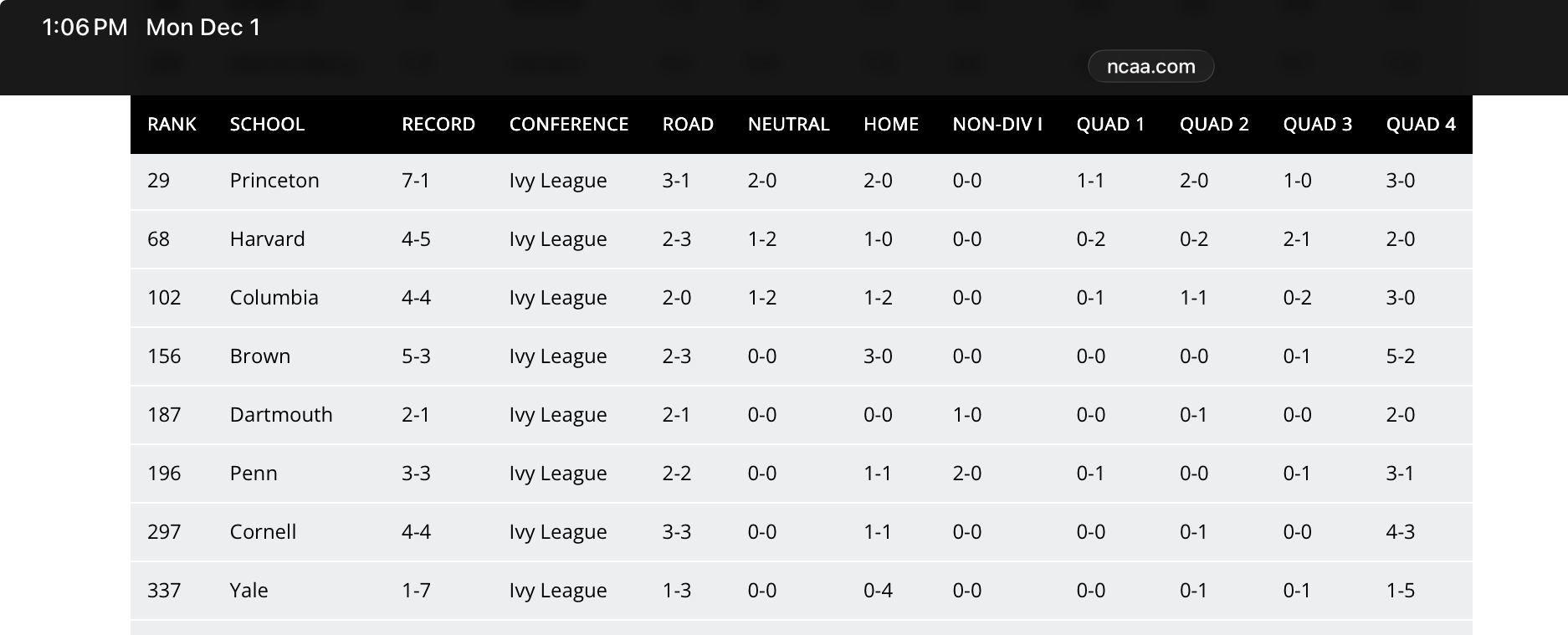
First Women’s NETs are out - and naturally still a work in process - but a baseline for 1 Dec.

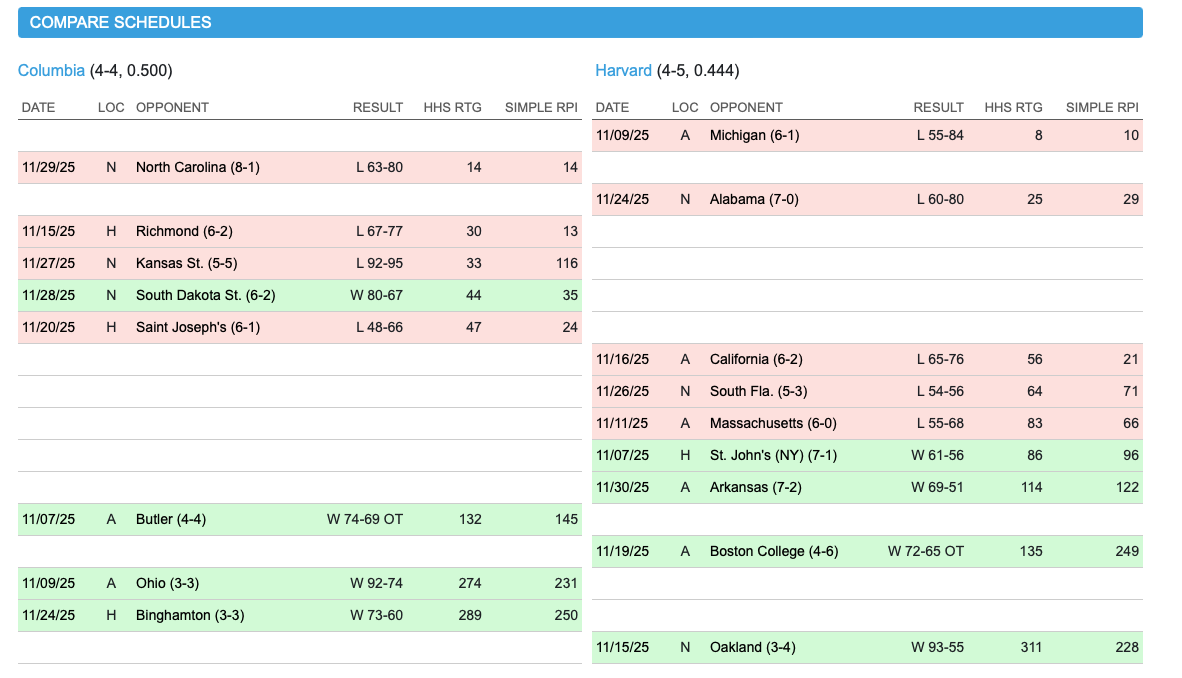
Over the next month—especially as Ivy play approaches—we’ll get a lot more “useful” results that help the NET settle into something closer to reality. For example, why is Harvard’s NET currently so much higher than Columbia’s? A big driver is current opponent mix: Harvard has already played more games against teams in the ~50–100 NET range and has been competitive in those matchups. Columbia, by contrast, hasn’t had many games in that band yet, which makes it harder (right now) for the model to properly calibrate where the Lions truly sit. For Columbia, games like Seton Hall and USTA will fill in that band.

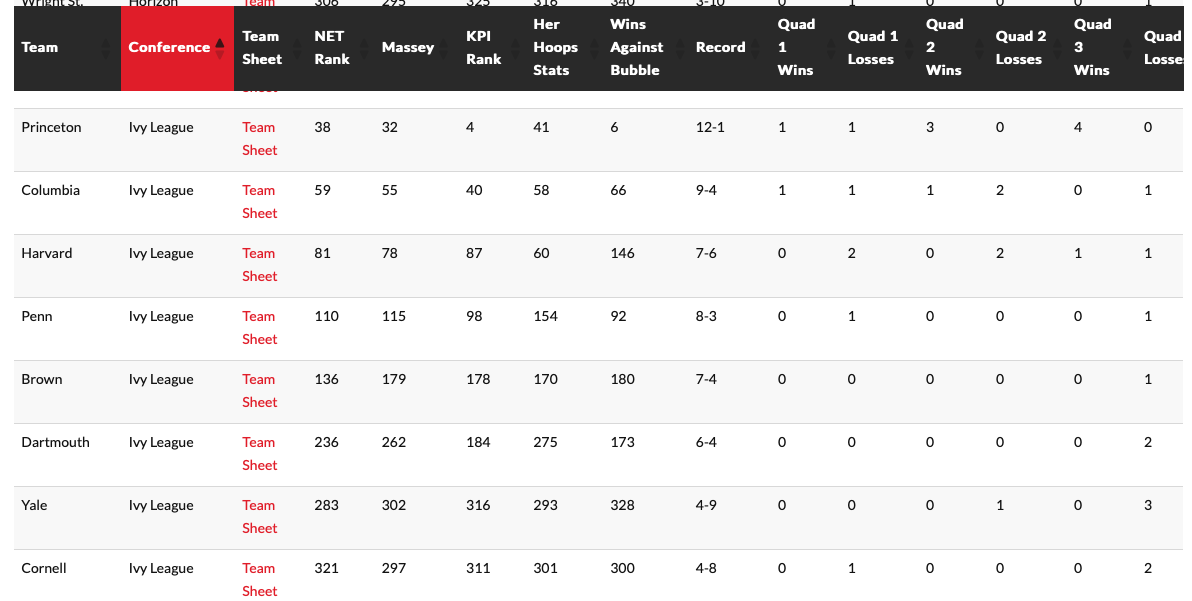
From HerHoopsStats:

1 Like

Happy New Year, Ivy Basketball Nation — and to your favorite shade of blue (or orange, green, etc.).

Ivy League Overview (through non-conference)

League results: The Ivies had a strong non-conference showing, going +16 overall (57–41) in D1 games, with six teams above .500. The league is currently #9 by average NET.

D1.ticker 2025-26 Comparative WBB Rankings - D1.ticker **

Big picture: This feels like we might have the tightest Ivy Madness Post COVID race. Models still lean toward separation at the top, but they may be too backward looking and on-court results suggest the gap is shrinking. The main year-over-year change: Columbia and Harvard are in degree of natural retool, while the rest of the league has generally played better, more winning basketball.

The 3 questions that decide Ivy seasons (same as always, but answers not as definitive)

I expect more upsets vs. the top three than we’ve seen lately. This year has real 2022–23 balance vibes: a path to five teams .500+ in Ivy play and a genuine battle for the #3 seed.

  1. Can you beat the team directly ahead of you at home?
    More likely with how compressed the middle looks.

  2. Can you sweep the team directly behind you?
    Not nearly as automatic this season – the spreads are generally withing 5 pts

  3. Can anyone besides Princeton/Columbia beat Princeton/Columbia?
    If we’re setting a line on combined regular season Ivy wins for Princeton + Columbia, I’d take the under on 26. I’d set it at 23.5.

**
Season End Projections using (Her Hoops Stats + Warren Nolan)**

Average both sources. The projected base case standings track the NET, but as Teams 2–5 are closer in NET there are more toss-up games, so there is more room for “upsets”. With 6-5 Mary Meng becoming eligible, Yale may be better than the OOC resume indicates. I feel Brown, Dartmouth and Penn may all have win totals that approach and in some cases exceed the Max.

  • Min = you lose all your toss-ups

  • Max = you win all your toss-ups

  • “Toss-up” = projected margin ≤ 5 points

Wins Base Min Max
Princeton 14.0 12.5 14.0
Columbia 11.5 10.0 13.0
Harvard 10.0 9.0 12.0
Penn 7.5 6.5 9.0
Brown 7.0 5.0 8.0
Dartmouth 2.0 2.0 5.0
Yale 2.0 0.0 3.0
Cornell 2.0 0.0 3.0

Key First Circuit Matchups

Game 1: Harvard at Dartmouth & Brown at Yale

  • Early home tests (with time to prep) to see how real Dartmouth/Yale improvement is.

Game 2: Columbia at Harvard & Penn at Brown

  • These track closely with preseason expectations for the 2–3 and 4–5 bands. Brown and Harvard enter as slight favorites — and I believe these are must-win for both. Reason: first tiebreaker is head-to-head, and neither Brown nor Harvard is likely to be favored in the end of season Game 14 return legs. Lose here and you’re effectively chasing two games, plus needing resume help to flip tiebreak math.

Game 3: Harvard at Penn

  • Big positioning game and a major tiebreak opportunity. Not a must-win for Penn, but Harvard is the contender most likely to drop a game to someone outside the Princeton/Columbia tier — so the Crimson can’t donate this one and the Quakers gain a lot with this tiebreaker.

Games 6 & 9: Columbia & Princeton

  • Both Friday nights, likely TV windows — slight edge Princeton given some concerns about depth. It would be slight edge Columbia if both games were Saturday night. Also worth noting: Columbia has Penn the following Saturday after each of these, which is a nasty back-to-back spot.

**
Postseason Outlook (if you don’t win Ivy Madness on March 14)**

NCAA at-large

  • Princeton is the only Ivy starting clearly “off the bubble” (38 NET) and strong WAB (6) footing, so they can absorb the right losses. My rule of thumb: 2 Ivy losses can still get an at-large; 3 gets into last 4 in / first 4 out territory.

  • Columbia (~59 NET) has the familiar blueprint: 12–2 / 13–1, avoid bad losses, and win enough games decisively to move the metrics. The issue is WAB (66) — it’s built around ~NET 45 baseline, so the Lions have more to move than the NET implies to reach the bubble.

  • Harvard (~81 NET) has too much ground to make up without a very big Ivy season.

WBIT

  • Top seed in Ivy Madness gets an automatic WBIT bid if it doesn’t win the tournament.

  • Typically low-80s NET = safe; ~105 NET is the extreme edge of selection history.

  • Princeton’s “worst case” still looks like WBIT.

  • Columbia and Harvard likely project in today, though Harvard is closer to the cut line – The Crimson missed out in 2024 with an 89 NET

  • Either Brown or Penn will have a plausible WBIT path, but likely need a marquee regular and likely post season Ivy win (Columbia/Harvard), clean wins vs. teams below them and perhaps a bit of bracket luck.

WNIT

Ivy League does not participate (not NCAA-sponsored).

**
All Ivy Thoughts**

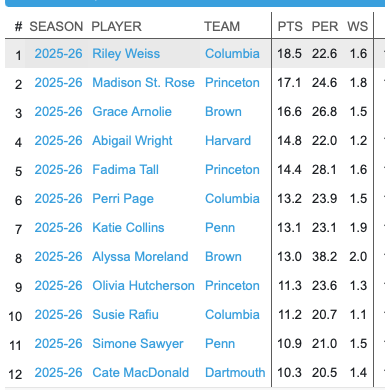
Not that Out Of Conference stats count towards All Ivy – but All Ivy recognition is highly correlated with scoring and defense player of the year is generally based on rebounding – sometimes seeming less so than the intangibles that happen on the court.

All Ivy: Here are the top 10 currently scoring 10+ ppg with a PER > 20 and a WinShare > 1.

Player of the Year: Likely will come down to Weiss or St. Rose

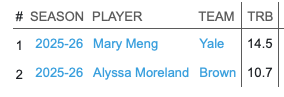
Defensive Player of the Year - The two with a 10 rpg average (per Her Hoops Stats) - Moreland had the advantage with her scoring.

image

Rookie of the Year: Wide open - Adams-Lopez is the front runner - but freshman should begin to see more playing time

image

2 Likes

Fantastic work. Yale, after looking like one of the 5 worst teams in the country in November, has quietly played better recently. Meng/Kastal/Vydrova is not a bad post rotation and Moore has been great.

Must know the secret formula … within 10 on 1 Jan!

Team 1/1/26
Brown 135
Columbia 59
Cornell 324
Dartmouth 235
Harvard 82
Penn 116
Princeton 38
Yale 280

Forget about an at-large bid for Columbia this year… will be nearly impossible to make up for a 7-pt loss at home to Cornell.

1 Like

Long way to go..

Woof. Barttorvik has it as the biggest D1 vs D1 upset of the past 2 seasons. (Could be more but he just added women’s basketball at the start of last season)

One bad shooting day by Weiss (1-14) and everyone is back to the drawing board with their crystal balls. Cornell 10-19 from deep? Hard to lose when you shoot like that

Worth noting that Chea was a nearly-as-bad 1-10 from the field today but the Tigers had enough to get by.

Still very early, but Berube’s crew has to feel like they swept a doubleheader today.