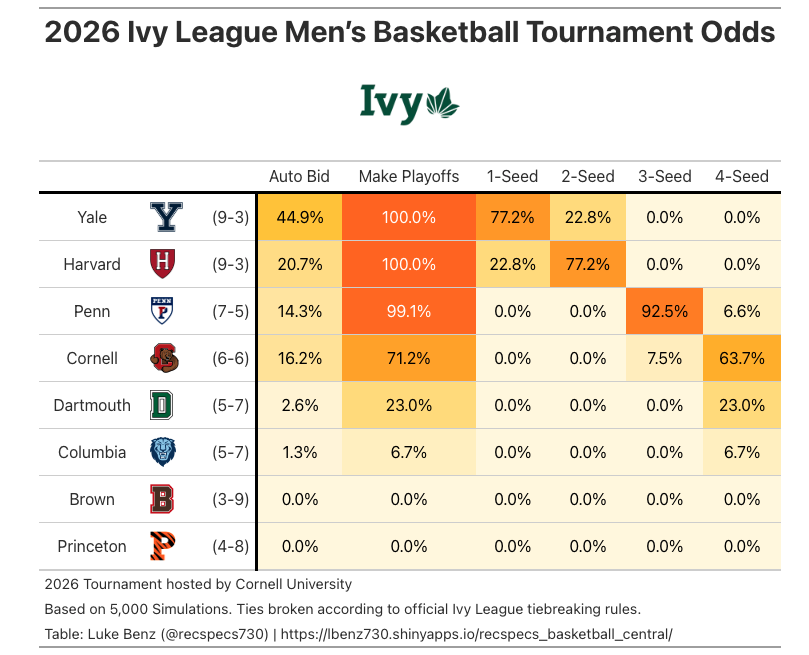
- Yale can clinch 1 seed tomorrow w/ win and Harvard loss.
- Columbia eliminated w/ a loss tomorrow
- Dartmouth eliminated w/ loss and Cornell win
- Cornell clinches w/ win and Yale > Columbia and Princeton > Dartmouth.
1 Like
Just to close this out, the seeding for Ivy Madness is finalized. No results next week can change the following order
(1) Yale
(2) Harvard
(3) Penn
(4) Cornell
If Penn/Cornell end up tied Penn has 2-0 head to head and wins tiebreaker. If Yale and Harvard end up tied, Yale wins by virtue of better record against Penn [again if Penn/Cornell end tied at the 3 seed the official rules dictate that because that lower tie can be broken by H2H, Penn would be the 3 and Cornell would be the 4 prior to breaking the tie for 1 seed]. Not that it would matter much any way as Yale also has a better record vs. a group of (Cornell/Penn) So no matter what, Yale is the 1 seed. Harvard beats Penn in any tie because of it’s win vs. Yale.
11 AM semi final in a true road game is one hell of a way to reward the top seed.
3 Likes
On the topic of the Ivy Madness home court advantage: in the 7 prior years, only once has the host location men’s team been a #3 or #4 seed. Penn was #4 in 2017 (at 6-8), and took a 14-0 Princeton team to OT before losing. Cornell is the weakest of the four men’s Ivy Madness teams this year, I think, but it would be nice to see a system of host sites that actually rewarded the top regular season performance(s).
2 Likes
3 times it has given the #2 seed home court in the title game over the #1 seed.
2018 (Penn over Harvard)
2019 (Yale over Harvard)
2023 (Princeton over Yale)
In all 3 cases I believe it was a case of co champions at least, but hard not to wonder if any of those title games end up differently if hosted at the top seed.
Penn and Harvard thank the Ivy League for its ridiculous “Let’s be Fair and Share the Tournament” format. After the most ridiculous ILT location is finished next season, it’s time for a proper neutral site to be selected somewhere in the NYC metro area. A 6000 or so seat venue would be the right size, so the best site would be the Carneseca Arena at St Johns, with possibilities on the low side at Monmouth (4200) or Bridgeport or Rutgers (10,000) on the high side.
Philosophically, absolutely. Of course the interminably debated issue has always been finding that venue acceptable to everyone, including cost.
I wonder what attendance we will see in Ithaca.
Long term weather prediction for Hanover, March 2027: blizzard the week leading up to the ILT.
The Ivy is in full no pay status and will not be at a neutral site. The Palestra will be voted down 6-2. I stand with my comments that the Ivy ends up at the house of the regular season winner starting in 28.
2 Likes
That seems an okay result. The logistics in a year when the regular champ is decided in the last week will be a challenge, but the event has generally not drawn huge numbers,
I will miss the men and women being together, but it does mitigate the logistics issue.
This will make advance ticket sales and hotel reservations very difficult.
Basketball is the crown jewel but for most sports where Ivy has a tournament, M/W are separate (at top seed) and logistics work out. M/W soccer, field hockey, volleyball, baseball, softball, M/W Lax.
1 Like
Logistics will be especially difficult if men and women regular season champs come from same school.
If the tournament ultimately shifts to a top-seed hosting model, I assume the game schedule itself would remain fixed, meaning all six games would still be played on the same dates and time windows currently planned for Ithaca.
That reality elevates one immediate logistical question: what happens if a single institution earns the right to host both the men’s and women’s tournaments?
Broadcast logistics alone argue for schedule stability - ESPN needs television windows locked well in advance, long before anyone knows where production trucks and equipment will actually be headed.
What would change materially is operational pressure on campus ticket offices. Schools would need to stand up postseason ticketing operations essentially overnight — managing inventory, seating plans, visiting allocations, and potentially deciding whether tickets are sold per session, per game, or as doubleheaders. On the positive side, each institution would gain a valuable real-time test case for future tournament hosting.
Speaking personally as an outlier who already had tickets and hotel rooms booked for Ithaca, the neutral-site model offered one major advantage: certainty. Advance planning was easy, and for those of us attending all six games, the ability to watch both the men’s and women’s tournaments in one location was a genuine benefit.
Which raises the broader strategic question:
How much incremental cost — financially and operationally — does a neutral site actually create relative to decentralized hosting?
Under a top-seed model, the league may ultimately need:
-
hotel blocks for four teams and staff across multiple potential host cities (in 2026: New York, Princeton, New Haven, Cambridge, etc.),
-
duplicated advance planning,
-
and league personnel split across simultaneous championship sites.
At some point, it’s fair to ask whether a rotating neutral site model - perhaps alternating between northern and southern Ivy locations - might offer simpler logistics, greater predictability, and comparable overall cost once travel and coordination complexity are fully considered.
1 Like
Out of curiosity, which is the other school (than Penn) that would vote for the Palestra?
Amaker at some point was on record in favor of it. Don’t know if he still is, but that would be my guess.
Princeton bc of proximity?
Again these schools already do all of this for every other sport where there is a tournament. Will more people show up to the Ivy League basketball tournament than Field Hockey – most likely. But for the past 3+ years, the league has already operated in a model where it books handles the hotel blocking for teams, the possibility that the same M/W school could host both tournaments, and doing this all when the final location isn’t locked in until a week prior to the event. And handling ticketing too.
I can’t comment on how much harder it would be to do that for basketball but let’s not pretend that it’s so hard they can’t figure it out when things have gone smoothly for other sports.
3 Likes
Are you kidding me???
Yes, that would be the last school in the world to admit that Penn is more suitable than it for, well, anything.
The winner of the regular season deserves to host the tournament. Period. There are only two schools whose gyms are large enough to make hotel logistics even worth talking about (Princeton and Penn) and both have ample accommodations nearby.
Remember that in 2011, the League pulled off the epic Princeton vs. Harvard playoff game at Yale on Friday, March 11 after Princeton forced the playoff after beating Penn just three days earlier. That was back in the day of in-person only, paper ticket sales and the tickets sold out within hours (at least the Princeton allotment). Logistics are so much easier now than they used to be.
1 Like