According to Columbia’s website there’s still an additional $27,000 of college expenses beyond tuition for the 25-26 school year.
Above $66k income yes. That is why I said tuition-free. Housing, food, etc is not covered for everyone below $150k, but there are multiple ways you can get aid for those things too (and quite easy to get). https://undergrad.admissions.columbia.edu/affordability/cost
Still, if you go to, say, Harvard’s site, it’s a much more generous and expansive offer over there.
2 Likes
Glad to have the Quakers back in the game, although I can’t remember the league’s representative getting hammered as hard as your boys did in the tournament, quaker3. Brown in the mid to late 80s maybe?. Ouch!
Tiger–they were competitive for a good half+. I can’t ever remember a Penn team getting blown out early of an NCAA tourney game.
As opposed to, say, Princeton in 2001, who were already trailing by 20 to UNC at halftime.
Cornell got blasted by arizona in ‘88
Yes, that was probably as bad of an Ivy pasting in a first round game as you could get.
1 Like
This is not a discussion about which team has been beaten the worst. I’m trying to understand how the Ivies can make recruiting fair so that each team has the same shot of fielding a competitive team without compromising academic standards. Why not say that all athletes have the same financial aid and transfer rules regardless of a school’s endowment? If that was implemented teams wouldn’t have the need to recruit junior college transfers.
Again, why single out those who are graduating from a 2 year college and transferring into a 4 year college? I teach a good number of these students myself at my 4 year college–that is a prejudiced view. Why assume that a rich high school lacrosse player shouldn’t have the same statement about him or her?
2 Likes
The rules are fine the way they are.
1 Like
I believe Eisgruber has said that in expanding the size of the undergraduate classes,
he hoped to make room for transfers, including from community colleges and those with
military experience. I don’t see any reason not to recruit JUCo kids if they can handle the
academic load.
I also don’t think we should equalize financial aid packages, so that athletes at HYP would get less than other students. Every Ivy has a lot to offer. Should Penn athletes be excluded from Wharton because not all Ivies have undergraduate business programs? As Penn’s experience this year shows. a good coach figures out a way to sell his program.
1 Like
/Users/jdp/Downloads/ivy-post.html
Apologies if the link doesn’t work — I’m only as tech-savvy as Claude lets me be.
What I built with Claude’s help is a tool that estimates how much financial aid each Ivy will actually provide, based on each school’s published aid formula and net price calculator. Drag the slider to any income level and the ranking reshuffles in real time.
The pattern is striking. At very low incomes, all eight schools converge near zero cost. At very high incomes, they all converge at full sticker (~$90K/year). But the path from free to full price is not a straight line — and it’s not the same path at every school.
Princeton is the most cost-effective by a wide margin, followed by Harvard, Yale, and Penn. Here’s the number that sticks with me: at $350K in family income, nearly every other Ivy is already at full price. Princeton is still in the $50K range.
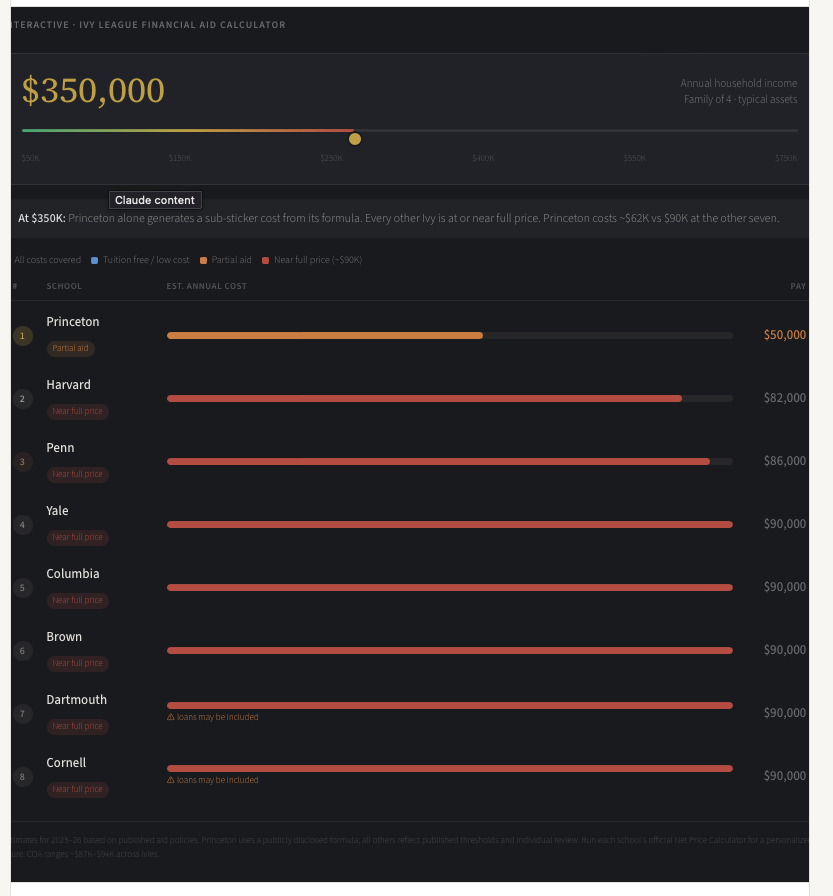
That $40K annual difference multiplied by four years is $160,000. That is real recruiting power — and it doesn’t require NIL.
If you cannot access the link - here is the just of the the post:
Most families assume the eight Ivy League schools offer roughly equivalent financial aid. They don’t. While all eight are need-blind for domestic students and promise to meet 100% of demonstrated need, the formulas they use to calculate what your family actually owes vary enormously — and the differences are worth six figures over four years.
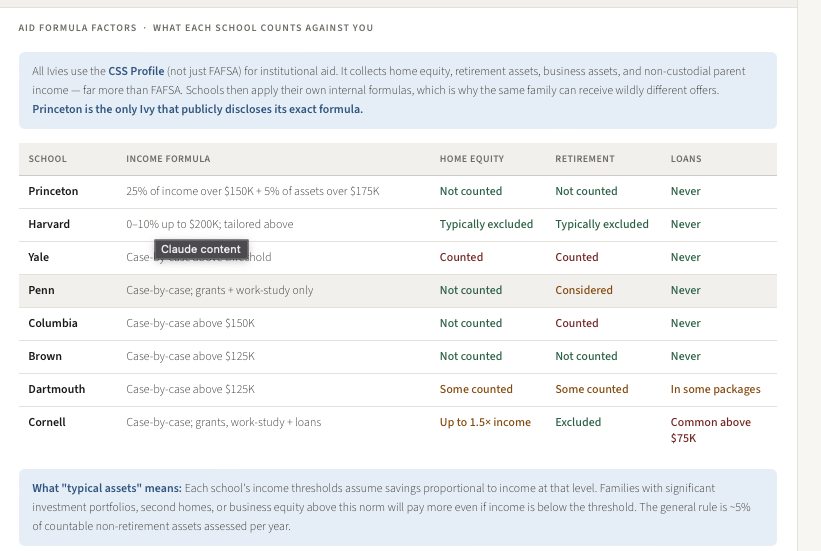
The real variable is what each school counts against you: income above certain thresholds, home equity, retirement assets, and whether loans are included in the package. Princeton is the only Ivy that publicly discloses its exact formula (25% of income over $150K, plus 5% of assets over $175K). Every other school conducts individual review, which makes comparison nearly impossible without running each school’s net price calculator.
At low incomes, all eight schools converge near zero cost. At very high incomes, they all converge at full sticker price — roughly $90,000 per year. But the path between those two points differs dramatically. Princeton reaches full price far later than its peers. At $350K in family income, when nearly every other Ivy is already charging full freight, Princeton’s estimated cost is still around $50,000. That $40,000 annual gap, multiplied by four years, is $160,000.
The ranking from most to least generous: Princeton, Harvard, Yale, Penn, Columbia, Brown, Dartmouth, Cornell. Cornell and Dartmouth are the only two schools that may include loans in some financial aid packages — a meaningful distinction that the sticker-price comparison obscures entirely.
The implication for athletics is underappreciated. The more affordable a school is across income levels, the broader its recruiting pool. When you can offer a family $160,000 more in grant aid over four years than your competitor, you don’t need NIL. For Princeton especially, the financial aid formula may be the most powerful recruiting tool in the Ivy League — and the strongest argument the league has for keeping NIL off the table.
What’s genuinely underappreciated — beneath the headline income thresholds that get all the attention — are the nuances buried in each school’s formula. The same family can submit identical financial information and receive dramatically different aid offers from different schools, all of which technically “meet 100% of demonstrated need.” That’s because “demonstrated need” is not a fixed number. It’s an output of each school’s own methodology, and the inputs they choose to weight — or ignore — vary significantly.
Home equity is a prime example. Princeton and Harvard largely exclude it. Yale and Cornell count it. A family sitting on $300,000 in home equity could see their expected contribution shift by $15,000 per year just based on which school is doing the math. Retirement assets follow a similar pattern. And then there’s the non-custodial parent rule: every Ivy requires financial information from both parents in a divorce — but how aggressively each school pursues and weights that data differs in practice.
This is why “case-by-case review,” the phrase most schools hide behind, produces outcomes that can look arbitrary from the outside. It isn’t arbitrary — but the criteria are opaque, the weighting is proprietary, and two families with nearly identical profiles can walk away with very different bills. Running each school’s net price calculator is the only way to get a real estimate, and even then the calculator is an approximation of a process that ultimately involves human judgment.
3 Likes
Thanks—very helpful information. Of course, Cornell has the state college within the University which is substantially lower tuition for New York residents.
Ron Lieber’s THE PRICE YOU PAY FOR COLLEGE is the best single resource I’ve found on this topic. Colleges are by and large very opaque, at best, when on this topic and a lot of this on the individual level is dependent on what a college needs in any particular year.
The elite UC campuses use community-college transfers as a way to accomplish their ethnic diversity goals in the face of Proposition 209 and general public disgust with identity-based preferences. Sparse anecdotal faculty opinion over the years about the relative academic performance of these transfers varies–some have told me that they were basically non-overlapping distributions, others see little difference.
The devil is in the details. I believe that the non HYP schools already have the ability to match a better aid package from HYP for a recruit, but the problem there is that you have to get an offer from HYP first to get a package to match. Kind of tough to recruit in that posture. And others have already pointed out why it may not work to otherwise even the playing field with set aid packages across at all 8 schools.
what a slop-inspired thread… glad it was on this board.
This aged about as well as your usual schtick does. So they lost to a Final 4 team and were only down 5 with 5 to go in the first half without their two best players. Hope you enjoy the upcoming run.
1 Like
McCaffery to Richmond.
Oh hey, ANOTHER transfer for the Quakers. Their 8th in the last 3 years. Wonder if he got the same $250k TJ Power got.